
When a Water Heater Fails: What It Damages and What It Costs
Failure modes by tank age, pan and drain-line failure, garage versus interior-closet damage, and the case for replacement at 10–12 years.
Failure modes by tank age
Most tank water heaters fail between 10 and 12 years. The mechanism is internal corrosion — the glass lining cracks, the anode rod depletes, and the tank corrodes from the inside until a seam or the bottom lets go. The failure is usually a slow weep that becomes a larger release, not a single catastrophic burst, which is why a heater past 10 years is on borrowed time.
Gilbert's housing stock — median build year 2003 — is now hitting the 20-year mark, and original water heaters installed at construction are at or past service life. San Tan Valley's single decade of stock is hitting the water-heater failure window at the same time as the supply-line window, which is why both failure modes appear together in those calls.
Pan and drain-line failure
A correctly installed pan under the heater catches a slow leak, and the drain line carries it outside. That system fails three ways: the pan was never installed (common in older stock), the drain line is clogged or terminated indoors, or the failure is fast enough that the pan overflows before the drain can keep up. A pan only protects against a slow leak; a tank-bottom failure can outrun it.
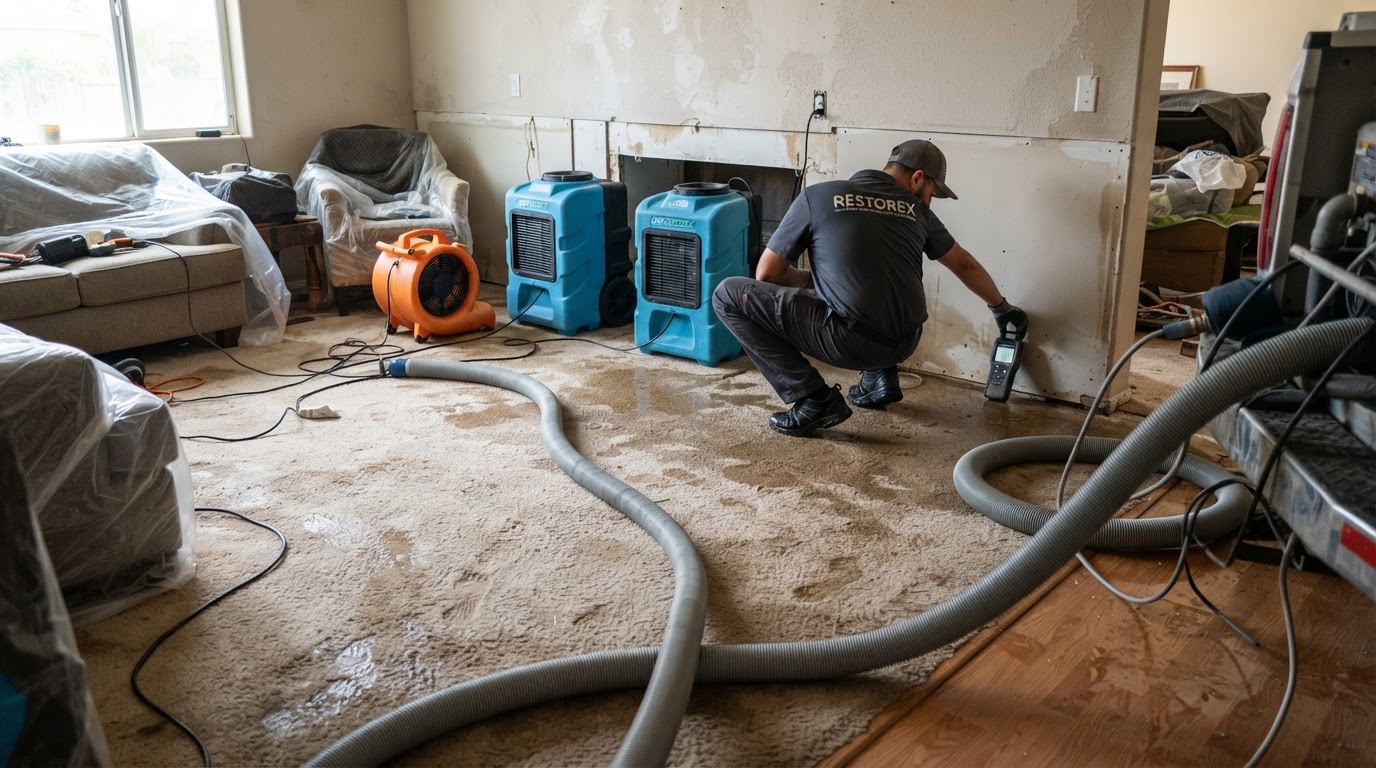
The fix on the plumbing side is a pan with a properly terminated drain line; on the restoration side, a pan overflow that reached the floor is a standard extraction and drying scope — small if caught the same day.
Garage versus interior-closet damage
Where the heater sits changes the damage. A garage failure spills onto a concrete slab, often contained and easier to extract — the water does not wick into drywall or framing the way it does inside the living envelope. An interior-closet failure, common in Mesa's pre-2000 stock where the heater is in an indoor closet or hallway, spills onto drywall, carpet, and framing, wicking up walls and into adjacent rooms.
The interior-closet scope is larger: cut-back of wet drywall, drying of the wall cavity with injectidry, and antimicrobial on the framing. The garage scope is often just extraction and slab drying. Same response, different scale — and the location of the heater in the home is the variable that sets it.
The case for replacement at 10–12 years
Replacement at 10–12 years is cheaper than a failure. A scheduled water-heater swap is a plumbing job; an unscheduled failure is a plumbing job plus a water-damage restoration scope, plus the disruption of a flooded room. The anode rod can be inspected and replaced to extend life, but the tank itself has a finite corrosion clock.
On the water-damage side, a caught-early water-heater loss is often a small scope — extraction and slab or closet drying — and stays Category 1 clean water. A failure that runs for hours or contacts building materials degrades and grows the scope. The response is the same 60-minute crew, the same IICRC S500 process.
Related water damage help
Frequently Asked Questions
How long does a water heater last before it leaks?+
Most tank water heaters fail between 10 and 12 years. The tank corrodes from the inside, the anode rod depletes, and a seam or the bottom lets go. A heater past 10 years is on borrowed time.
What is the difference between a garage and an interior-closet water heater failure?+
A garage failure spills onto a concrete slab, often contained and easier to extract. An interior-closet failure — common in Mesa's pre-2000 stock — spills onto drywall, carpet, and framing, wicking up walls and into adjacent rooms.
What does a pan and drain line do?+
A correctly installed pan under the heater catches a slow leak and the drain line carries it outside. A failed, missing, or clogged drain line means the pan overflows and the water reaches the floor anyway.
Get a free assessment today
Whether it's happening right now or you found a stain this morning, our crew can be on site within 60 minutes. Call the emergency line or send a few details and we'll call you back.
Call (480) 555-0123