
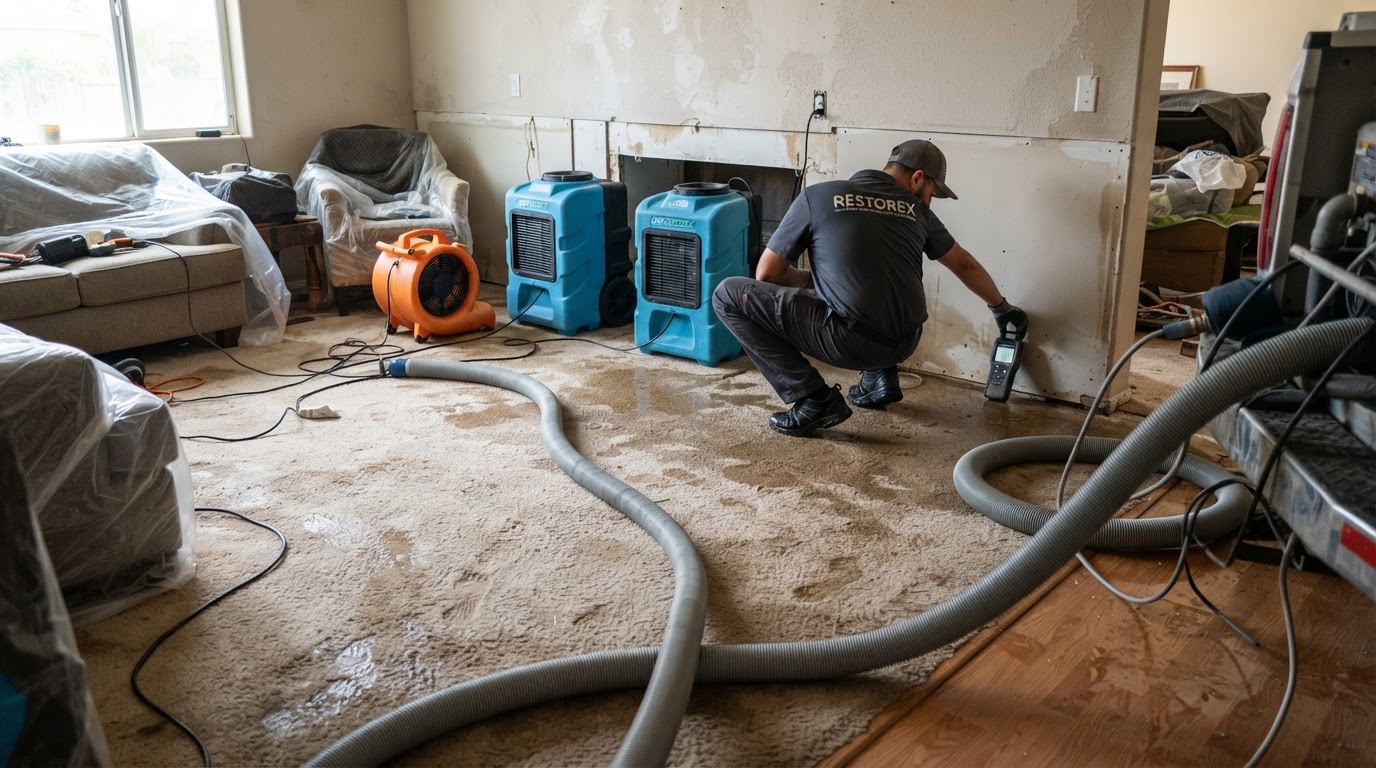
Water Damage Cleanup and Repair in Mesa, AZ
Emergency water extraction, structural drying, and repair — IICRC S500 process, direct insurance billing, crews on site within 60 minutes.
Emergency Water Extraction and Removal
Water extraction is the first hour of every water loss, and it is the hour that matters most. We run truck-mounted extraction units and submersible pumps for standing water, and weighted extraction tools to pull water from carpet and pad that a wand alone would leave behind. The response commitment is in numbers: crews on site within 60 minutes, with extraction beginning the same visit.
For contents at risk, we stage a contents pack-out — furniture, electronics, and boxed goods moved off the wet envelope, inventoried, and held while the structure dries. Every minute water sits is a minute of wicking up drywall and into framing; the same-visit extraction is what keeps a Category 1 loss from degrading.
We also handle standing-water removal from crawlspace, subfloor, and finished basement — anywhere a hose can reach and a pump can push. The goal is a dry structure before any drying equipment is placed, because dehumidifiers evaporate residual moisture, they do not pump standing water.
Structural Drying and Dehumidification
Drying is applied physics. We hold a drying gradient with LGR (low grain refrigerant) dehumidifiers for typical residential losses, desiccant dehumidifiers for dense or hard materials, and a mix of axial and centrifugal air movers to drive moisture off surfaces and into the air where the dehumidifier can pull it.
For wall cavities and hardwood, we use injectidry systems — positive and negative pressure through drilled ports — to move air through spaces a surface dehumidifier cannot reach. Negative air machines with HEPA filtration scrub the air as we dry, so airborne mold spores do not redistribute.
The science is psychrometrics — grains per pound of moisture in the air, relative humidity, and temperature, all read together. We log baseline readings on day one and daily after, tracking the drying curve until the structure hits drying standard. 3–5 days is typical; we verify with moisture meters before any reconstruction begins. This is the IICRC S500 standard, applied.
Daily moisture logs and psychrometric readings are the deliverables you and your adjuster receive — the documentation that proves the loss was stabilized and dried to standard, on a timeline.
Active water loss? Every hour changes the scope and the bill. Call now — crews on site within 60 minutes.
(480) 555-0123The Water Damage We See Most in Mesa
Burst pipes and supply-line failures
Braided connector failure under sinks and washing machines, polybutylene fittings from late-1970s to mid-1990s construction, and pinhole corrosion in original copper. The supply line is the most common single cause of water loss we see in Mesa. Why Phoenix pipes burst.
Slab leaks
Under-slab leaks driven by expansive clay soils and hard-water scaling that narrows copper lines and raises internal pressure. Detected with moisture mapping and thermal imaging before extraction. Slab leaks in Arizona.
Water heater failures
Tank age past 10–12 years, pan and drain-line failure, and the difference between a garage failure (concrete, contained) and an interior-closet failure (drywall, carpet, framing). Water heater leak damage.
Ceiling and drywall damage
Roof penetrations, second-floor supply lines, and AC condensate lines that back up and travel down through living-space ceilings. Wet drywall cut back and the cavity dried with injectidry where possible.
Flood and storm damage cleanup
Monsoon flash flooding and wash overflow from an inch of rain in under an hour. We extract, dehumidify, and document the loss for the sudden-and-accidental claim. Monsoon water damage in Mesa.
Sewage backup — Category 3 black water
Any water that has contacted potential pathogens — sewage, ground-surface water, drain backup — is Category 3. It is handled differently: full containment, removal of all porous contact materials, antimicrobial application, and HEPA filtration. It costs more because the scope is larger.
Categories and Classes: What Determines the Job
Water Categories
- Category 1 — Clean water
- From a clean source: supply line, rainwater entry, tub overflow. Dries in place if responded to fast.
- Category 2 — Grey water
- Washing machine discharge, dishwasher, clean toilet overflow. Contaminated enough to require antimicrobial treatment.
- Category 3 — Black water
- Sewage, ground-surface water, any water contacting potential pathogens. Full containment and porous-material removal.
Category 1 degrades to Category 2 within 48 hours as it contacts building materials and microbial growth begins — which is why response time changes both the scope and the bill.
Evaporation Classes
- Class 1
- Least absorption — part of a room, minimal wet material. Fastest to dry.
- Class 2
- Whole room, carpet and pad, low-permeability materials wet up to 12 inches up the wall.
- Class 3
- Whole room saturated, ceiling involved, water wicking above 12 inches. Most equipment.
- Class 4
- Deeply held moisture in low-permeability materials — hardwood, plaster, concrete. Longest drying, desiccant required.
What It Costs, and What Insurance Pays
Typical Phoenix-area water mitigation runs $3,200–$8,500, with reconstruction as a separate line item. What drives the price: category of water, affected square footage, materials involved, and drying duration. Category 3 costs more than Category 1 because the scope is larger; a Class 3 loss costs more than a Class 1 because it takes more equipment for longer.
On the insurance side, most claims turn on the sudden-and-accidental versus gradual distinction — that is what decides most files. Sewer and drain backup requires a separate endorsement, commonly sublimited at $5,000–$25,000. And watch the deductible: percentage deductibles of 1–3% of dwelling value against a Mesa median home around $408,000 means a 2% deductible is $8,160 — so a smaller loss may not be worth claiming at all. What water damage restoration costs in Arizona and filing a water damage insurance claim.
A same-day response costs less than a three-day-old loss — not because our rate changes, but because the scope does. Mold begins colonizing wet material in 24–48 hours, and once a Category 1 loss degrades to Category 2, the antimicrobial and containment scope is larger and the bill with it. That is also the link to our mold remediation work — water damage is the upstream cause, and the 24–48-hour mold window is where mitigation ends and mold work begins.
Commercial Water Damage
One section, not a silo. We handle water loss for property managers, HOAs, restaurants, and retail — after-hours response, tenant coordination, and business-interruption documentation for the carrier. Commercial scopes run larger equipment and tighter timelines; we split it into its own page only if it earns the traffic.
The after-hours call is the whole point for commercial work. A restaurant line break at 2 a.m. and a retail supply-line failure before open both need the same thing: a crew on site before the next shift, extraction started, and a documentation package ready for the adjuster and the owner by morning.
Frequently Asked Questions
Most residential water losses reach drying standard in 3–5 days under LGR dehumidifiers and air movers. Extraction begins the same visit, and reconstruction is scoped separately after moisture verification.
Get a free assessment today
Whether it's happening right now or you found a stain this morning, our crew can be on site within 60 minutes. Call the emergency line or send a few details and we'll call you back.
Call (480) 555-0123