
Monsoon Water Damage in Mesa: What the Season Actually Does
Must publish ahead of the June 15 season open. The NWS window, the damage modes, and why a short intense burst floods more than a long gentle rain in the flat Valley.
The NWS window and the real numbers
The NWS monsoon window runs June 15 – September 30, peaking mid-July through August. The season delivers about 2.56 inches — roughly a third of annual rainfall — and the year-to-year swing is enormous: 9.57 inches in 1984 against 0.15 inches in 2023, with recent seasons running below normal.
The number that matters for water damage is not the season total — it is the intensity of a single event. An inch in under an hour, delivered as a microburst, floods more than a week of gentle rain because the flat Valley terrain does not drain quickly and the water arrives faster than the ground and the washes can move it.
Microbursts at 100+ mph
A microburst is a collapsing column of cold air that hits the ground and radiates outward at 100+ mph. The wind drives rain sideways into roof penetrations, vents, and windows that ordinary rain does not reach, and it damages roofing directly. The water entry from a microburst is wind-driven rain through a forced opening — sudden and accidental in insurance terms.
The damage mode is water intrusion at the roof and the window line, not ground flooding. That means the scope is ceiling and drywall, attic insulation, and whatever the water traveled down through — different from a slab leak, different from a wash overflow.
Haboobs, outflow winds, and drainage
A haboob is a dust storm driven by the outflow of a collapsing storm cell. The outflow winds arrive before the rain, and they carry fine dust that silts up drainage — gutters, downspouts, scuppers, and the drains at the low point of a flat roof. When the rain does arrive, the drainage is partly blocked, and water pools where it should run off.
The restoration implication: after a haboob-then-rain event, the drainage itself needs clearing as part of the scope, or the next storm repeats the loss. The water damage side is the pooling and intrusion that the blocked drainage caused.
Flash flooding, flat-roof pooling, and wind-driven rain
Flash flooding from an inch in under an hour overwhelms washes — Queen Creek Wash and Sonoqui Wash carry genuine flash flooding into adjacent subdivisions — and pools at low points in the flat terrain. Flat-roof pooling happens when scuppers and drains are blocked or undersized; the water weight itself can stress the roof and find a seam. Wind-driven rain around roof penetrations and windows is the most common monsoon intrusion — it enters where a vent, a pipe boot, or a window flashing has dried out and cracked.
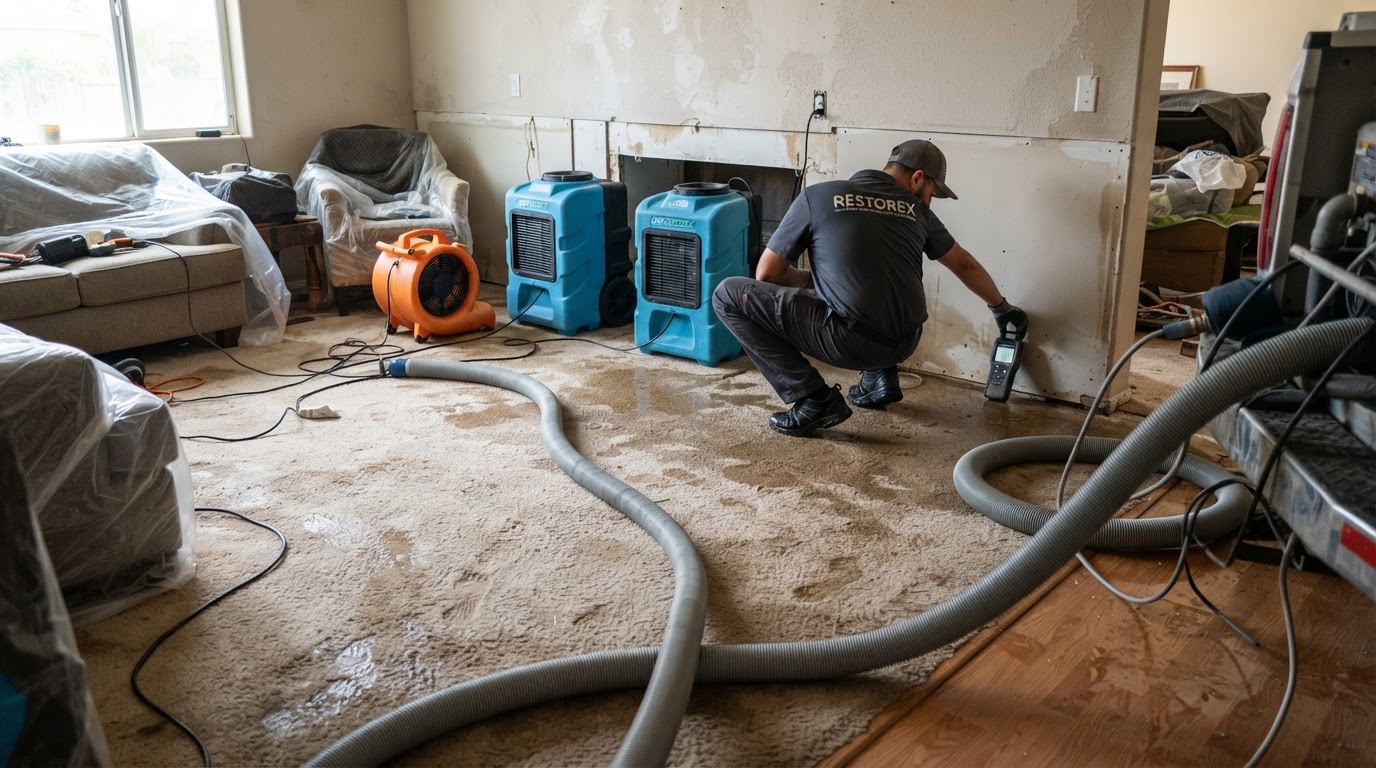
Each damage mode has a different scope. Flash flooding is ground-surface water and often Category 3; flat-roof pooling is ceiling and insulation; wind-driven rain is localized intrusion at a penetration. The common thread is that monsoon water damage is sudden and intense, and a same-visit extraction is what keeps a Category 1 loss from degrading.
Related water damage help
Frequently Asked Questions
When is monsoon season in Mesa?+
The NWS monsoon window runs June 15 through September 30, peaking mid-July through August. The season delivers about 2.56 inches — roughly a third of annual rainfall — via microbursts, haboobs, and flash flooding.
What monsoon damage does homeowners insurance cover?+
Wind-driven rain through a sudden opening is generally covered as sudden and accidental. Ground-surface floodwater entering the home is typically not covered without a separate flood policy. Sewer and drain backup needs a separate endorsement.
How much rain causes flash flooding in Mesa?+
An inch of rain in under an hour can overflow washes and pool on flat roofs. The flat Valley terrain does not drain quickly, so a short, intense burst floods more than a long, gentle rain.
Get a free assessment today
Whether it's happening right now or you found a stain this morning, our crew can be on site within 60 minutes. Call the emergency line or send a few details and we'll call you back.
Call (480) 555-0123