
Mold Remediation and Removal in Mesa, AZ
IICRC S520 mold remediation — containment, HEPA filtration, antimicrobial application, and third-party clearance testing. Free assessment.
Mold Remediation Services in Mesa
Mesa Water Restoration is Mesa's mold remediation company, specializing in containment-based IICRC S520 removal, mold inspection and air sampling, and water damage restoration — the upstream cause of most mold we see. We serve Mesa, Gilbert, Chandler, Tempe, Queen Creek, San Tan Valley, and Apache Junction, 24/7, with direct insurance billing. Work performed by Drip Restoration, ROC #324316.
Containment & Negative Air
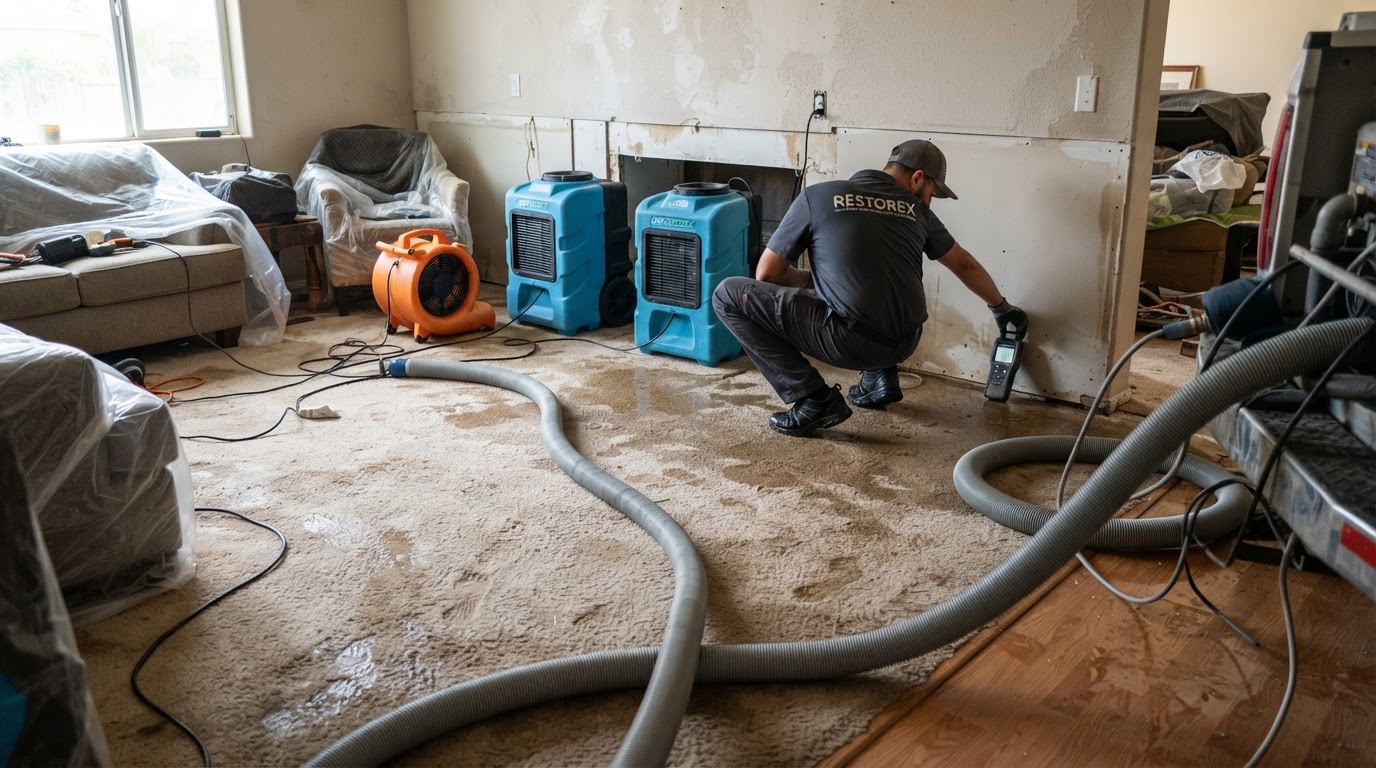
Six-mil polyethylene containment with HEPA-filtered negative air machines holding the affected area under negative pressure so spores do not migrate.
HEPA Filtration & Air Scrubbing
Air scrubbers and HEPA-filtered negative air machines run through the job to pull airborne spores out of the air as we work.
Antimicrobial & Biocide Application
Non-porous surfaces HEPA-vacuumed and treated with antimicrobial and biocide; porous materials removed rather than treated.
Porous Material Removal
Drywall cut back 12–18 inches beyond visible growth; insulation, carpet, and pad removed and bagged under containment.
Black Mold (Stachybotrys) Removal
Species-specific scopes for Stachybotrys chartarum, Aspergillus, Penicillium, and Cladosporium — the species we see most in Mesa.
Post-Remediation Verification
Third-party clearance testing — spore counts inside versus outside the containment — before the containment comes down and reconstruction begins.
How Remediation Actually Works
Mold remediation is governed by IICRC S520, and the method is containment-first. We build containment with six-mil polyethylene sheeting, seal the entry, and place the area under negative pressure with HEPA-filtered negative air machines. Negative pressure means air flows into the containment from the clean side, and nothing — spores, dust, debris — flows out.
Inside containment, we remove porous materials — drywall cut back 12–18 inches beyond visible growth, wet insulation, carpet and pad — bagged under containment. Non-porous surfaces — framing, studs, concrete — are HEPA-vacuumed and treated with antimicrobial and biocide. Air scrubbers and HEPA filtration run throughout to pull airborne spores out of the air.
The job ends with post-remediation verification — third-party clearance testing that compares spore counts inside the containment to an outdoor baseline. The containment does not come down, and reconstruction does not begin, until clearance is documented. That separation is the whole point: the people who clean verify the people who cleaned.
Species matters for the scope. Stachybotrys chartarum (black mold) is a chronic moisture indicator and drives a full containment scope; Aspergillus and Penicillium often co-occur and indicate a water source; Cladosporium is the most common indoor mold we see and the most responsive to a contained removal. We identify by species where the clearance scope requires it.
Active water loss? Every hour changes the scope and the bill. Call now — crews on site within 60 minutes.
(480) 555-0123Black Mold and What the Species Mean
"Black mold" is a label, not a diagnosis. Stachybotrys chartarum is the species people mean by it, and it is an indicator of chronic moisture — it needs sustained wetness to colonize, so finding it means the water source has been there a while. It is not uniquely more dangerous in its mechanism than other molds — all molds can affect indoor air quality — but it is a signal that the underlying leak must be fixed before remediation will hold.
Aspergillus and Penicillium are fast colonizers that often appear together and indicate an active water source. Cladosporium is the most common indoor mold we see in Mesa and the most responsive to a contained, HEPA-vacuumed removal. Each gets a species-appropriate scope; the clearance testing confirms the removal worked regardless of species.
Stachybotrys chartarum
Chronic moisture indicator — full containment scope
Aspergillus
Fast colonizer, often co-occurs with Penicillium
Penicillium
Active water source — pairs with Aspergillus
Cladosporium
Most common indoor mold in Mesa — contained removal
Why Mesa Homes Grow Mold in a Desert
The differentiator on this page, and the objection every Phoenix homeowner raises: "It's a desert — how do I have mold?" The mechanism is simple. Mold does not need ambient humidity. It needs a wet substrate. And a wet substrate is exactly what wall cavities, under-slab leaks, AC condensate lines, evaporative cooler overspray, and post-monsoon roof penetrations all supply.
Growth begins in 24–48 hours on wet cellulose — drywall paper, framing lumber, dust in a wet cavity — regardless of what the outdoor dewpoint is doing. The dry air outside does not reach the wet inside of a wall. That is the whole mechanism, and it is why our mold calls trace back to a water loss more often than not. Water damage restoration is the upstream cause — and the link is not incidental.
The housing stock compounds it. Mesa is 70.3% pre-2000 housing with a median build year of 1989; the aging copper, polybutylene, and supply-line failures that drive our water calls are the same failures that create the wet cavities mold colonizes. Fix the leak, dry the cavity, and the mold cannot re-establish — which is why remediation without moisture source control always fails.
Cost and Insurance
Mold remediation cost scales with the affected area, the species, and whether porous materials must be removed. A contained bathroom ceiling is a smaller scope than a whole-house wall-cavity job; we scope the loss before quoting, and third-party clearance testing is a separate line item so the test and the fix never share an invoice. Mold inspection and testing is a separate intent and a separate page.
On insurance: mold resulting from a covered sudden-and-accidental water loss is generally covered up to policy limits, though some policies cap mold specifically. Gradual or long-term moisture is typically excluded — which is why slow under-slab leaks and long-standing condensate damage are often out-of-pocket. We document the cause and the timeline for the adjuster either way.
Frequently Asked Questions
Mold begins colonizing wet cellulose material in 24–48 hours. The desert climate does not prevent it — the moisture inside a wet wall cavity is what matters, not the outdoor dewpoint.
Get a free assessment today
Whether it's happening right now or you found a stain this morning, our crew can be on site within 60 minutes. Call the emergency line or send a few details and we'll call you back.
Call (480) 555-0123