
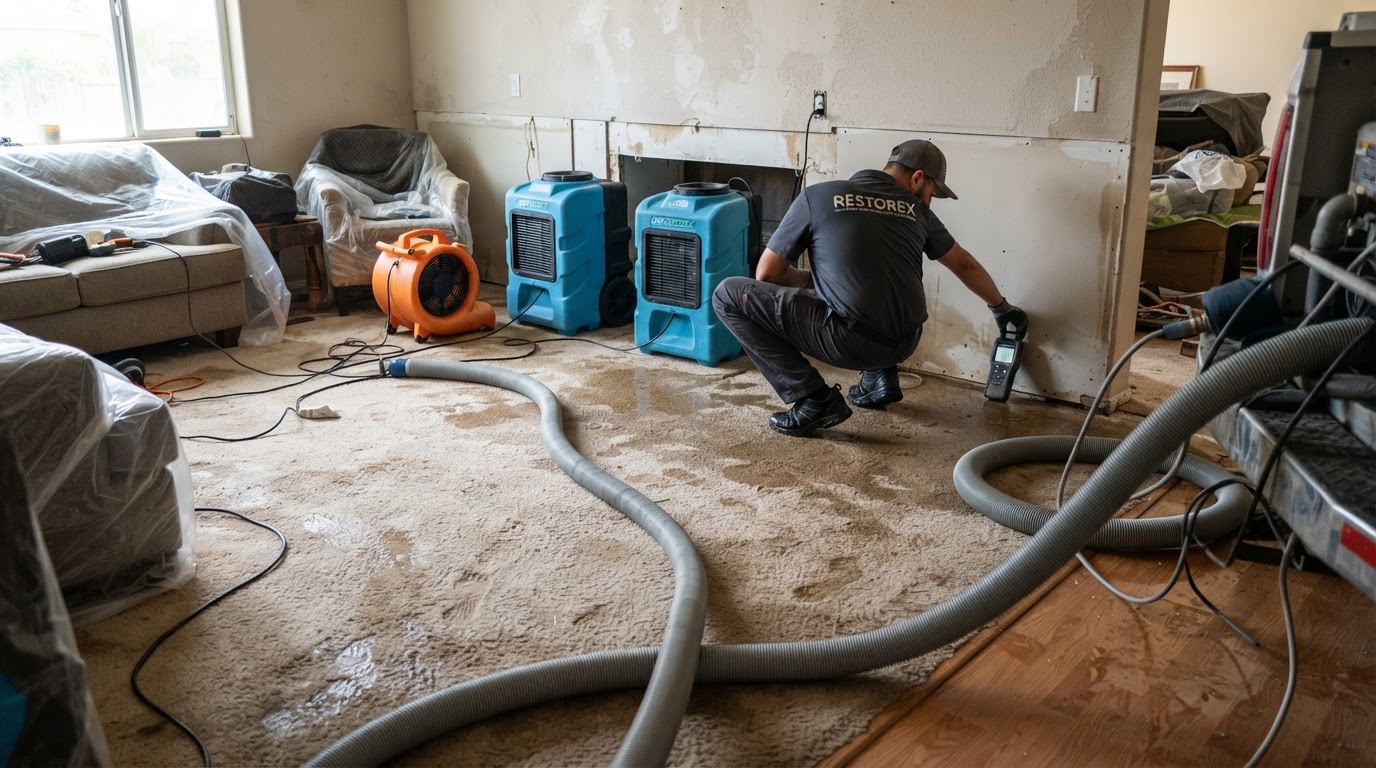
Mold Inspection and Testing in Mesa, AZ
Independent mold inspection and air quality testing — moisture mapping, spore-trap air sampling, surface sampling, and accredited third-party lab results you can act on.
What a Mold Inspection Includes
Mesa Water Restoration is Mesa's mold inspection company, specializing in independent mold inspection and air quality testing, moisture mapping, and post-remediation clearance. Inspection and remediation are separate intents — one tells you if you have it, the other fixes it — and we keep the boundary clean. We serve Mesa and the East Valley, 24/7. Work performed by Drip Restoration, ROC #324316.
Visual Inspection
A room-by-room walk looking for visible growth, water staining, condensation, and the moisture sources that feed it.
Moisture Mapping
Penetrating and non-penetrating moisture meters map the wet envelope — where moisture is now and where it has been.
Thermal Imaging
Infrared reveals temperature differentials behind walls — the signature of wet insulation and hidden moisture that a meter alone can miss.
Spore-Trap Air Sampling
Air samples pulled per cubic metre and compared to an outdoor baseline — the measure of how much is actually airborne.
Surface Sampling
Swab and tape-lift sampling on visible growth to identify the species and the severity of contamination.
Bulk Sampling
Physical material samples where species identification or confirmation requires lab analysis of the substrate itself.
Air Sampling vs Surface Sampling
Air Sampling
Spore-trap air sampling measures airborne spore counts per cubic metre and compares the indoor reading to an outdoor baseline. It answers "how much mold is in the air I'm breathing?" — the right question when there is a smell with no visible source, a health complaint, or a whole-home concern. We pull multiple samples across rooms and compare them to a same-day outdoor control.
Surface Sampling
Swab and tape-lift surface sampling picks up what is actually growing on a visible spot, identified to species by an accredited third-party lab. It answers "what is this stain?" — the right question when growth is visible and you need to know whether it is Stachybotrys, Aspergillus, Penicillium, or Cladosporium for the remediation scope. Bulk sampling — a physical piece of the substrate — is used when the substrate itself must be analyzed.
Both go to an accredited third-party lab; the report compares indoor versus outdoor spore counts and identifies species where surface samples are pulled. The result is a lab report you can act on — or hand to a remediation contractor, a landlord, or an adjuster.
Active water loss? Every hour changes the scope and the bill. Call now — crews on site within 60 minutes.
(480) 555-0123Reading Your Lab Results
A mold lab report is not a pass/fail document — it is a comparison. The number that matters is the indoor spore count per cubic metre read against the outdoor baseline pulled the same day. An indoor count well below the outdoor baseline is normal — spores are everywhere. An indoor count above outdoor, or a species indoors that is not outdoors, is the signal.
Stachybotrys indoors at any elevation is meaningful — it does not travel from outdoors the way Cladosporium does, so finding it inside means a source. Aspergillus/Penicillium elevated indoors against outdoor indicates an active source. We walk you through the report, explain what each number means, and tell you plainly whether the result warrants remediation or not.
For post-remediation clearance, the test is whether indoor counts have returned to outdoor baseline and whether the species of concern is no longer elevated inside the containment. That clearance is the document that closes the job.
When You Need Testing and When You Don't
The section that earns this page. Say plainly: visible growth on a known wet surface usually does not need a test before remediation — you already know. Save the cost. Where testing earns its money:
- A smell with no visible source — musty odor behind a wall you cannot open without the air data to justify it.
- A health complaint — respiratory symptoms a resident attributes to the home, where the lab result is the evidence.
- A real-estate transaction — buyer or inspector requiring a documented clearance before close.
- A landlord-tenant dispute — independent documentation of a condition.
- Post-remediation clearance — the independent test that verifies the remediation worked before the containment comes down.
Competitors all sell the test. Being the page that says when to skip it is both correct and, in this SERP, differentiating — and it is why we keep inspection and remediation as separate intents. Mold remediation is the other intent; this page never targets it, and that one never targets "mold inspection." Each mentions the other once and links; neither optimizes for the other's term.
Frequently Asked Questions
Usually not. Visible growth on a known wet surface does not need a test before remediation — you already know it is there. Testing earns its cost when there is a smell with no visible source, a health complaint, a real-estate transaction, a landlord-tenant dispute, or for post-remediation clearance.
Get a free assessment today
Whether it's happening right now or you found a stain this morning, our crew can be on site within 60 minutes. Call the emergency line or send a few details and we'll call you back.
Call (480) 555-0123